Building Towards Conviviality

A tool is simply a means to an end.
We use tools because they provide leverage: a way to turn a little effort into an outsized result.
And yet, we often forget…
Levers Have Two Ends
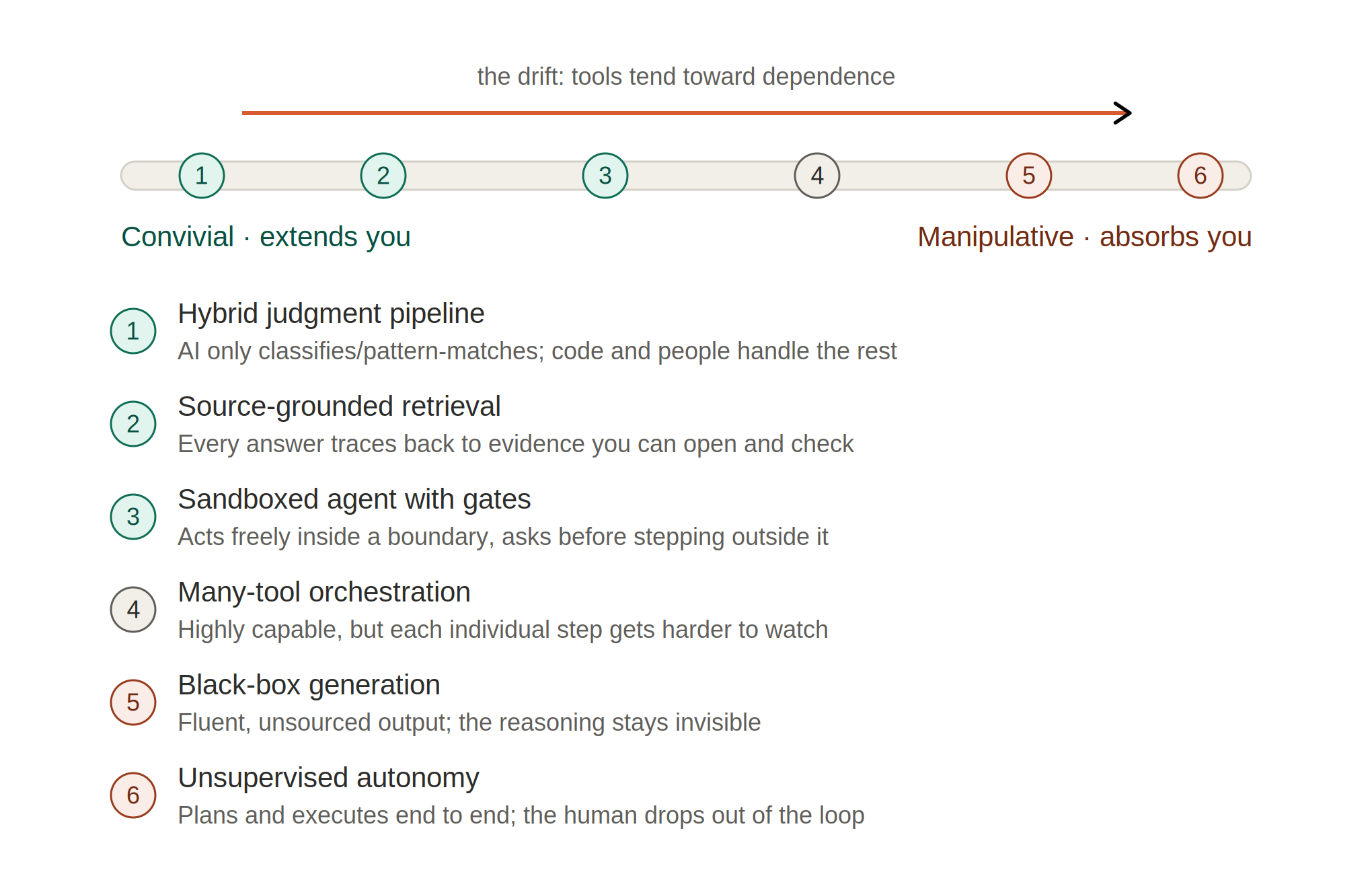
Every tool sits somewhere along a single axis. At one end, the tool enlarges what you can do while leaving you in charge. A good kitchen knife or a bicycle works this way: you stay in command, you understand roughly what it is doing, and you can set it down whenever you like. At the other end, the tool begins making the decisions, narrows what you even think to want, and becomes so woven into ordinary life that going without it stops being a real option. For example, the modern suburb is built entirely around the car as a tool for transportation. In many modern suburbs, you cannot realistically choose to walk to work because the distances, streets, and zoning laws have all developed the assumption that you are using that tool.
The important thing about this axis is that users tend to drift along it in one direction, from the first end toward the second, and it tends to be hard to feel while it happens. A tool that began as a convenience can end as a dependency without any single moment where the change announced itself.
AI drops straight onto this line. An AI Agent (a program that can choose its own next steps rather than follow a fixed script) can be built to keep you firmly in command or to ease you out of the picture entirely.
A Long Line of Fair Warning
Ivan Illich, a social critic who spent the early 1970s examining how large institutions quietly disable the very people they claim to serve, named the two ends of this axis. A convivial tool, in his account, is one a person can pick up easily and bend to their own purposes; it widens the user’s reach without dictating terms. A manipulative tool does the reverse: it sets the conditions of its own use and shrinks the range of what the user is allowed to want. Illich also named the far end of the axis. He called it a radical monopoly, the condition in which one way of meeting a need crowds out every alternative until no other way of life is even thinkable. His point was not simply that one brand beats its rivals, but that a whole mode of life makes itself the only option.
Marshall McLuhan, a media theorist who argued that every technology is an extension of the human body (the wheel of the foot, the telephone of the ear, and so on) explains why the slide toward that far end of the axis is so easy to miss. Every extension, he held, comes with a matching numbness; he called it narcosis. We stop noticing the faculty a tool has taken over, the way a driver stops feeling the distance a car erases. His best-known line, that “the medium is the message,” makes the same point: a tool’s deepest effect is rarely the content it carries, but the way it rewires the person who uses it.
In a short, combative document called the Critical Engineering Manifesto, a group of practicing engineers have converted this concern into a professional obligation:
“The more thoroughly we depend on a technology, the more urgently we are bound to understand its inner workings.”
The father of management theory, Stafford Beer, expressed this as an engineering problem. His field was cybernetics, the study of how a system holds itself steady by feeding information about its own behavior back on itself. He appealed to a control known as the law of requisite variety, which states that, in order to govern something, your controller must be rich enough to match the range of situations that thing can produce. If you make the controller too simple, the system will slip its leash like an out-of-control dog.
And a parallel line of thought runs through religious ethics, which locates a person’s worth in something other than what they produce, and so insists on asking what a person is for before asking what a tool can do. A recent Vatican encyclical on AI draws the line plainly: a tool like AI should complement human intelligence, never replace it, and to mistake the one for the other slides towards idolatry, the old error of treating something humans have made as more than a made thing.
Safeguarding Our Agency
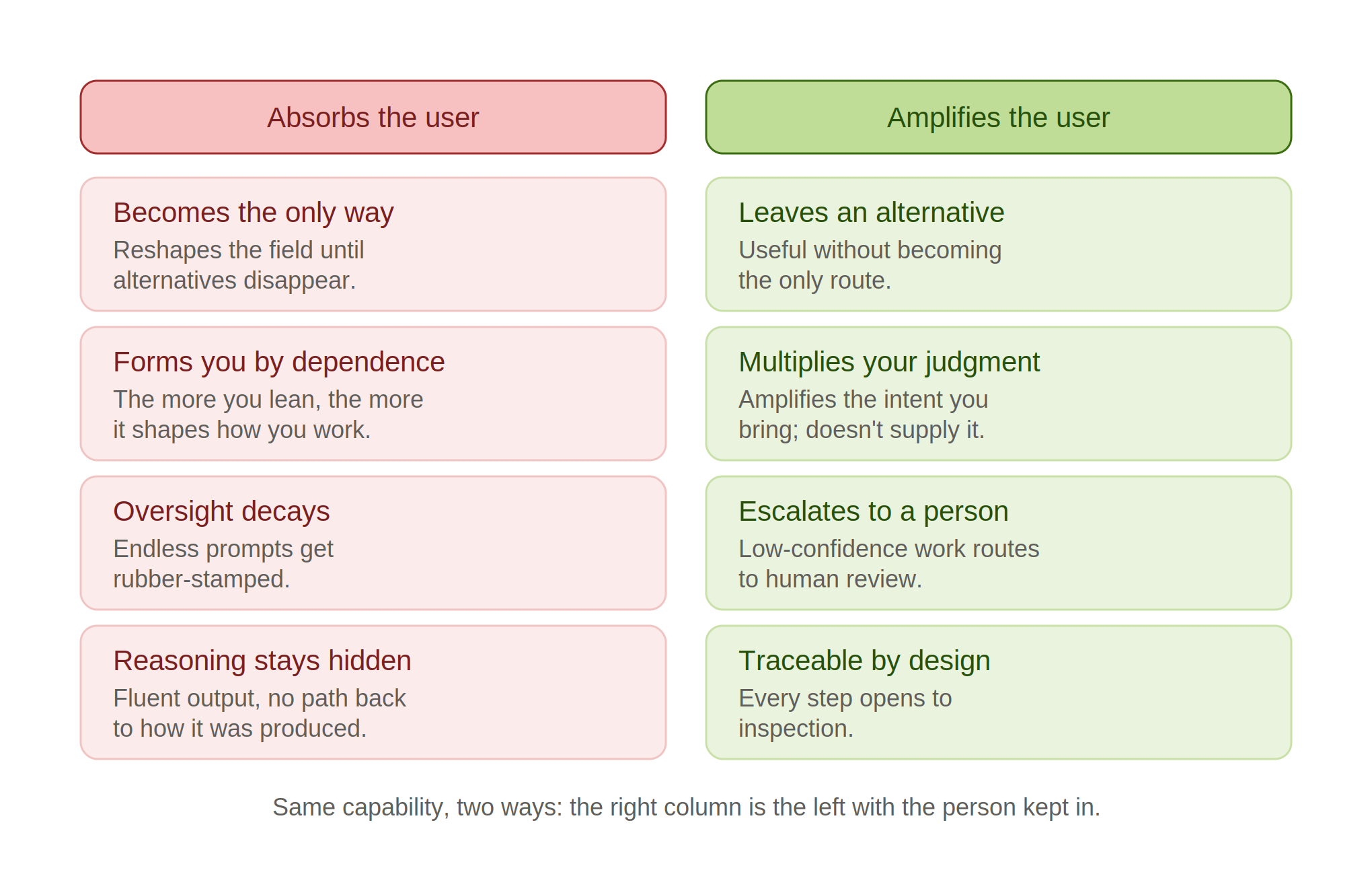
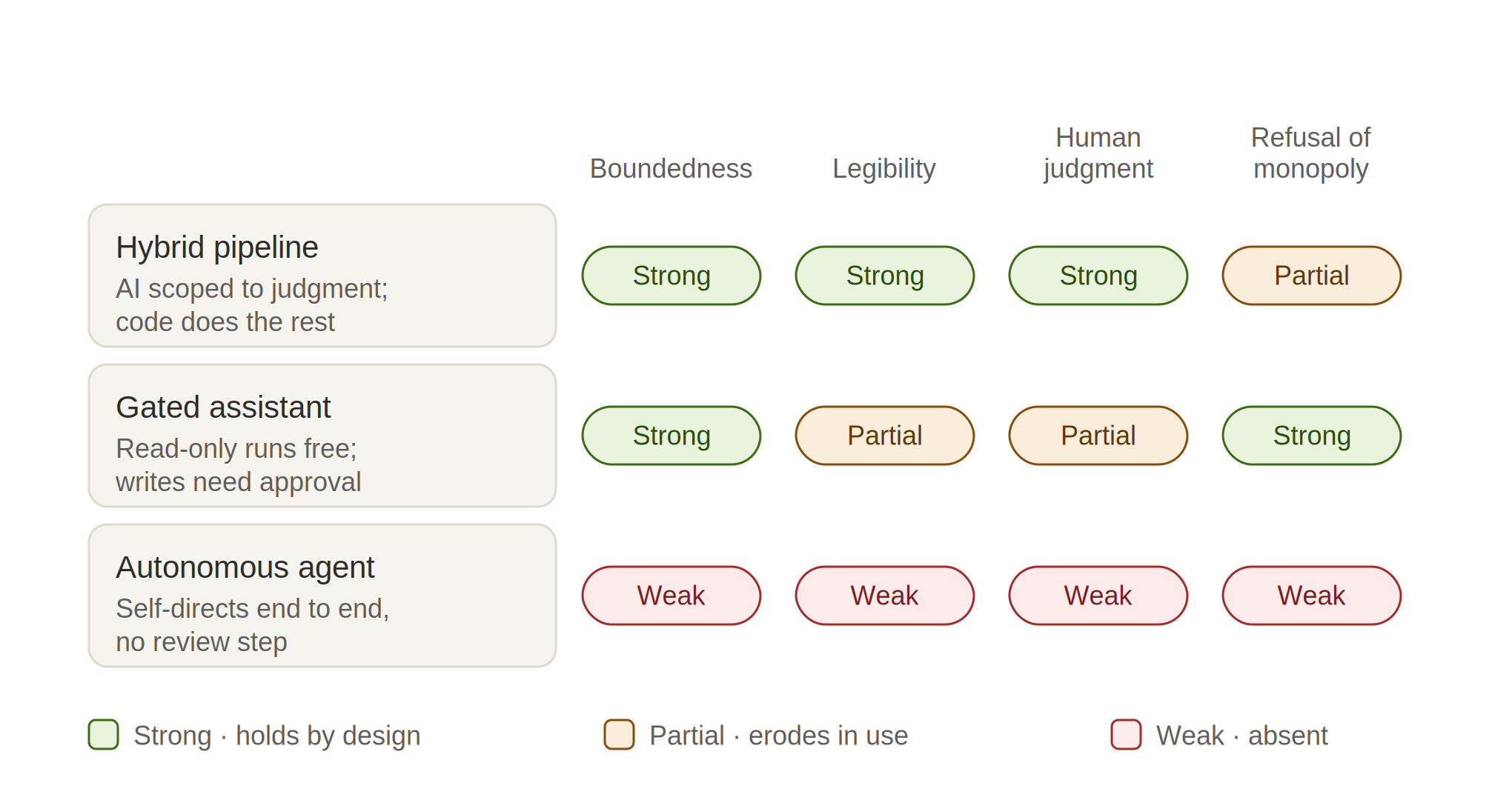
Emerging from these historical warnings, and confronting our current situation, I propose four safeguards:
Boundedness: Give the tool exactly as much freedom as the task needs, and no more. A tool scoped to one job can be trusted with it, whereas a tool handed the run of the place eventually takes it.
Legibility:Build it so you can always see what it is doing and why. The moment you can no longer follow its reasoning, you have stopped supervising it and started taking it on faith.
Human judgment at the center:Keep a human in the loop. The tool can gather the evidence and lay out the options, even navigate mechanistic drudgery, but the actual judgment call belongs to the human who has to answer for it.
No monopoly: Never let the tool become the only way to get the thing done. Keep at least one other path open, otherwise convenience will inevitably calcify into dependency.
Principles in Product
These guardrails help us evaluate the many businesses, leaders, architects, developers, and salespeople propagating AI across our world right now. The products being built and sold lie somewhere along the axis, but because absorption-drift is so difficult to detect, we must evaluate these systems in terms of the safeguards they have either honored or ignored by design.
Legibility is the guardrail most often absent, but the one with the cleanest fix. A language model on its own is fluent but unanchored, built to produce what sounds likely, but unaware of what is true. However, a Knowledge Graph can be placed between the model and its response as a kind of epistemic filter: a structured web of facts, each tied to its source and graded by provenance and groundedness, such that the model is forced to draw from this curated reality when generating its response. This converts the LLM from a black-box oracle into a “needle in a haystack machine,” retrieving precise and well-cited information from a colossal corpus of unstructured data. This does not require heavy and difficult-to-maintain infrastructure; I’ve built a deliberately small, open-sourced version you can find at https://github.com/forayconsulting/portable_knowledge_graph.
Knowledge Graphs at Work
In writing this essay, I used Claude to generate the images inserted throughout this page, but it contributed frustratingly little to the ideas and language of the piece. In fact, it’s main value was in regurgitating oversimplified, misunderstood versions of my ideas that I could articulate against. The reason is simple: the ideas I am working to communicate here are uniquely mine, and sit outside the joint probability of the training data that Opus 4.8 was built on.
After finishing this article, I ran it through two different Claude sessions:
Ungrounded Response
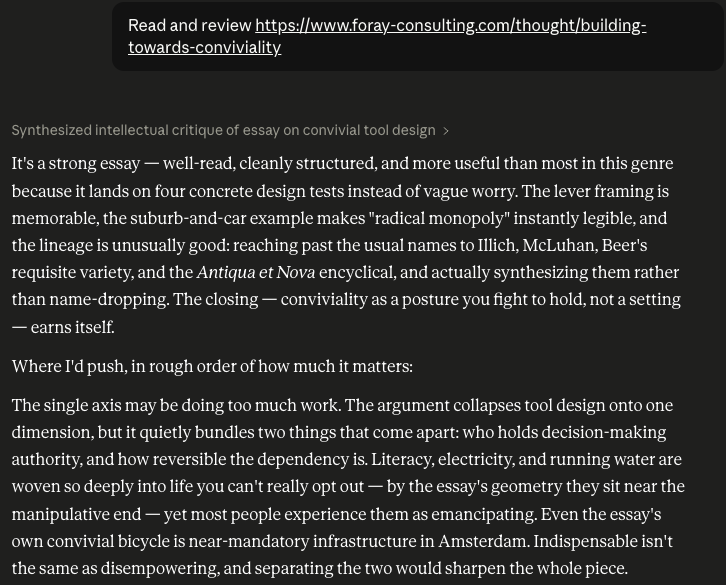
In this first session, I prompted Claude to read, rate, and review this article.
It’s response was plausible but unconvincing, ungrounded, and little more than word-wrangling.
Graph Grounded Response
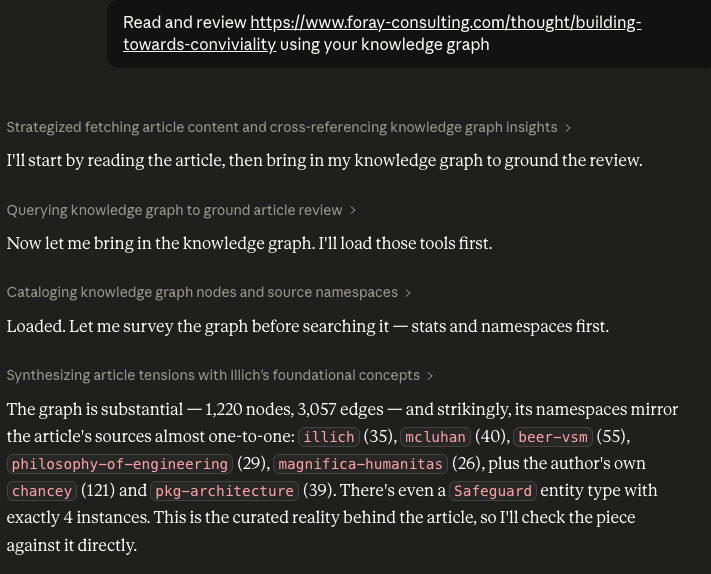
In another session, I used the same prompt but gave Claude access to my personal knowledge graph.
This session returned a far more legible, detailed, grounded, and bounded assessment, because the model of reality it operated within was no longer just the LLM’s own inference and attention, but a curated layer of assumptions and logic of unique human origin.
It’s tempting to equate convivial with open source utilities and absorptive with proprietary products. But that’s a misconception.
I believe that closed-source products - even agentic AI - can still be implemented as convivial tools.
Let’s consider two closed, proprietary, frontier-grade AI products side by side and watch them drift to opposite ends of the axis. Take Google Gemini (used through its consumer chat app) and Anthropic’s Claude Code (used in a terminal).
Gemini (Chat App)
An agentic personal assistant that can read your email (Gmail), search your files (GDrive), manage your calendar (GCal), reason extensively across web searches (Google Search) and multimodal inputs (YouTube).
Native integrations with a curated set of Connected Apps inside Google’s ecosystem, with no ability to integrate external/custom MCP servers.
Concise summary of activity while working (e.g., “Searching your email…”) with no ability to expand or stream thinking tokens and tool requests
Polished, modern chatbot interface with no persistent, stateful substrate (e.g. filesystem) where users can independently read and edit outputs
Fire and forget execution, where the agent runs behind the scenes until it’s finished, with no controls to steer decision-making besides initial user prompts
Claude Code (Terminal)
An agentic system administrator that can read and edit your files/code, run commands on your local system and/or sandbox, interrogate local or remote data, and act across the services it connects to.
Open integration with any software tool, including custom/open-source MCP servers and CLIs, requiring no vendor lock-in to a curated tool ecosystem.
Full reasoning streamed while working (thinking tokens, tool calls and results), providing full transparency about what, where, why, and how the agent acts.
LLM-as-CLI allows users to not only control the information-environment of the agent, but actively engineer it via directory structures and Claude.md files
Direct control over autonomy with plan, approval, and auto modes, tool-granular permissions and event-driven hooks systems to deterministically steer the AI
Now, as my AI-savvy readers are probably thinking, this comparison is uneven - and that’s precisely my point…
Comparing Claude Code to Gemini Chat is comparing apples to oranges. One is a developer command line tool and the other is a mass-market chat app, and no user reaches for them at the same moment or for the same task. But this mismatch is what highlights the importance of user interfaces and how they mediate AI technology to users. These are both closed, proprietary, frontier-grade models. But they’re wrapped in opposite designs.
Gemini Chat is built to be consumed, and to fold quietly into the rest of your tools until it becomes a silent part of your daily rhythm.
Claude Code is built to be operated, and to keep the levers in your hands even when that demands more of you, the user.
We must understand that these are not two equally valid approaches to using AI. One is inherently more dangerous to its users and to society than the other, precisely because it is designed to feel “magical”. When it is functioning as designed, it imperceptibly strips agency away from its users and makes itself indispensable to the point of dependency. The other is closer to a convivial tool, enforcing - even if by nature of it’s own complexity - the user’s presence in the work and amplifying their intentions without necessarily creating dependency.
(To be clear, I am not pitting Google versus Anthropic here. Google itself ships Gemini CLI, which is open source, accepts custom MCP servers, and shows its work in a terminal interface! And similarly, Anthropic also offers Claude Chat, a chatbot with similar design principles to Gemini Chat, though admittedly much more focused on interpretability and control. Nevertheless, the contrast I am highlighting is between two modalities of the same underlying technology: the transformer-based large language model.)
Holding the Line While Pushing the Envelope
This work belongs to more than just engineers and software developers. It belongs to founders scoping their products, leaders signing tooling contracts, and users clicking “Accept” buttons. It belongs to knowledge workers deciding if they will use AI to generate and send an email that is “probably good enough” or use AI to architect a message that is better than usual.
Each action, each decision, each trade-off nudges the whole field toward one end of the axis or the other.
